Garlic Water for Orchids: A Simple Homemade Orchid Care Solution
Introduction
If your orchid needs a little extra attention, a mild garlic-water solution is a simple homemade option that many plant enthusiasts use as part of their orchid care routine.
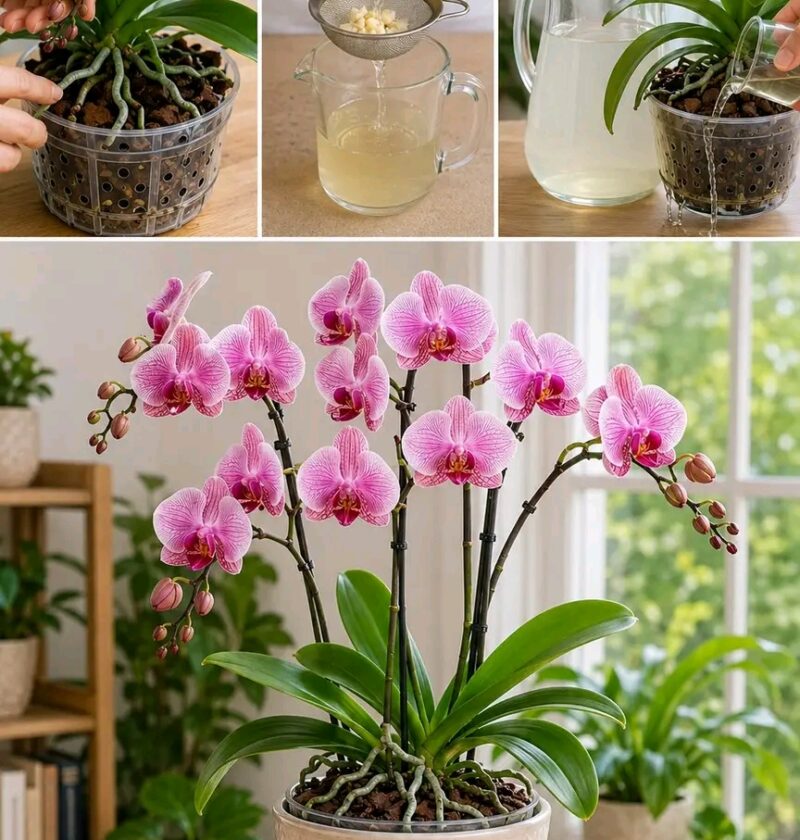
The method shown in the image involves soaking fresh garlic in water, straining the liquid, and using the diluted solution around the orchid’s growing medium. It is easy to prepare and requires only a few inexpensive ingredients.
However, garlic water should not be considered a proven fertilizer or a cure for orchid diseases.
Healthy orchids still need appropriate light, watering, airflow, potting media, and a suitable orchid fertilizer when necessary.
For reliable indoor plant care, think of garlic water as an optional home gardening practice rather than a replacement for proper orchid nutrition or pest and disease treatment.
Recipe Overview
| Category | Details |
|---|---|
| Recipe Name | Homemade Garlic Water for Orchids |
| Preparation Time | 5 minutes |
| Steeping Time | 8–12 hours |
| Straining Time | 5 minutes |
| Total Time | About 12 hours |
| Yield | Approximately 4 cups diluted solution |
| Difficulty | Very easy |
| Best For | Orchid care and routine watering |
| Suitable Orchids | Phalaenopsis and many common indoor orchids |
| Application | Watering the growing medium |
| Storage | Refrigerator for up to 2 days |
| Frequency | Occasional use rather than every watering |
Why You’ll Love This Recipe
This homemade orchid care solution is inexpensive, quick to prepare, and uses ingredients that are easy to find. You do not need specialized gardening equipment to make it.
The preparation is also gentle when properly diluted. Instead of pouring a concentrated garlic mixture directly onto an orchid, the finished infusion is strained and diluted before use.
For people interested in indoor gardening, houseplant care, and natural plant-care methods, this can be an interesting addition to an existing orchid routine.
The most important benefit is convenience. You can prepare a small batch in advance and use it when your orchid needs watering.
Ingredients
Garlic Water Concentrate
| Ingredient | Amount |
|---|---|
| Fresh garlic cloves | 2 medium cloves |
| Room-temperature water | 2 cups |
| Clean glass jar | 1 |
Dilution
| Ingredient | Amount |
|---|---|
| Garlic infusion | ½ cup |
| Clean water | 3½ cups |
| Total solution | 4 cups |
Using a relatively weak dilution is preferable to applying a concentrated garlic solution to orchid roots or potting media.
Step-by-Step Instructions
1. Prepare the Garlic
Peel 2 medium garlic cloves.
Lightly crush them with the flat side of a knife. You do not need to mince them into tiny pieces.
Crushing the cloves helps release their water-soluble compounds into the infusion.
2. Add the Water
Place the crushed garlic into a clean glass jar.
Add 2 cups of room-temperature water.
Close the jar loosely with a lid or cover it with a clean cloth.
3. Let It Steep
Allow the garlic to steep for approximately 8–12 hours at room temperature.
Avoid leaving the mixture for several days because an old organic infusion can develop unpleasant odors and microbial growth.
4. Strain Thoroughly
Pour the mixture through a fine-mesh strainer.
For an even cleaner solution, strain it a second time through clean cheesecloth or a coffee filter.
Remove all pieces of garlic before using the liquid on your orchid.
5. Dilute the Infusion
Mix ½ cup of the garlic infusion with 3½ cups of clean water.
This produces approximately 4 cups of diluted garlic water.
Do not use the undiluted concentrate directly on orchid roots.
6. Check the Orchid First
Before watering, inspect the roots and growing medium.
If the potting medium is still damp, wait until the orchid actually needs water.
For many Phalaenopsis orchids, roots that appear silvery or gray and a potting medium that has become mostly dry can indicate that watering is needed. Growing conditions vary, so avoid relying on a rigid calendar.
7. Apply the Solution
Slowly pour the diluted garlic water over the orchid’s potting medium.
Allow excess water to drain completely through the drainage holes.
Do not allow the orchid to sit in standing water.
8. Keep the Leaves and Crown Dry
Try to keep the solution away from the center of the plant where the leaves meet.
If water collects in the crown, gently remove it with a clean paper towel.
This is particularly important for Phalaenopsis orchids because prolonged moisture in the crown can contribute to rot.
Best Tips
Always use a clean container when preparing homemade plant solutions.
Clean equipment reduces the chance of introducing unwanted microorganisms into the solution or onto your orchid.
Use fresh garlic rather than old, moldy, or spoiled cloves. The goal is to make a simple infusion, not a fermented plant mixture.
The most important tip is dilution. A stronger solution is not necessarily better, and concentrated homemade solutions can potentially irritate roots or interfere with the growing environment.
Use garlic water occasionally rather than replacing every normal watering with it. Orchids still need appropriate moisture, light, airflow, and nutrients.
If your orchid has yellow leaves, mushy roots, black spots, or persistent pests, identify the underlying problem rather than relying on garlic water alone.
Best Ingredient Options
Fresh garlic: Fresh firm garlic cloves are the simplest option. Avoid garlic that has visible mold or spoilage.
Water: Filtered, rain, or suitable tap water can be used depending on your local water quality. If your tap water is very hard, filtered or rainwater may be preferable for some orchids.
Glass jar: A clean glass container makes it easy to see the infusion and keep the preparation covered.
Fine-mesh strainer: This is useful for removing tiny pieces of garlic before application.
Recipe Variations
For a very sensitive orchid, make an even weaker solution by using ¼ cup of garlic infusion with 3¾ cups of water. This is a cautious approach if you are trying the method for the first time.
You can also prepare a smaller batch by using one garlic clove with one cup of water, then dilute a small portion before application.
Avoid adding vinegar, dish soap, essential oils, bleach, or other household ingredients to the garlic water.
Combining unrelated substances can create a solution that is unnecessarily harsh for plants.
Do not combine homemade garlic water with commercial pesticides or fertilizers in the same container unless the product label specifically indicates that the combination is compatible.
What to Serve With
Since this is a plant-care recipe rather than a food recipe, there is nothing to serve with it.
Instead, use it alongside good orchid care practices, including appropriate lighting, proper drainage, suitable orchid potting mix, good air circulation, and regular inspection for pests.
A healthy orchid routine is much more important than any single homemade solution.
Make-Ahead Instructions
The garlic infusion can be prepared several hours before you plan to water your orchid.
After straining, dilute only the amount you expect to use.
For best freshness, avoid preparing large quantities and storing them for long periods.
Storage
Keep unused diluted garlic water in a clean, covered container in the refrigerator.
For best practice, use it within 24–48 hours.
Discard it if it develops an unusual odor, cloudiness, mold, or other visible changes.
Never store homemade plant solutions indefinitely.
Reheating
There is no need to heat or reheat garlic water before using it.
If refrigerated, allow the solution to return to approximately room temperature before applying it to the orchid.
Avoid using very hot or very cold water because sudden temperature changes can stress plant roots.
Freezing
Freezing is not recommended.
The recipe is inexpensive and quick to prepare, so making a fresh small batch is preferable to freezing and thawing the solution.
Common Mistakes to Avoid
One of the most common mistakes is using concentrated garlic water directly on the roots. The solution should be diluted before application.
Another mistake is watering an orchid simply because a certain number of days has passed. Indoor temperature, humidity, pot size, potting media, and light exposure all affect how quickly an orchid dries.
Do not leave water standing inside the decorative outer pot. Orchids need good drainage, and constantly wet roots can lead to root problems.
Avoid pouring homemade garlic water into the crown or leaving droplets between the leaves. If water accumulates there, gently dry the area.
Finally, do not expect garlic water to replace orchid fertilizer.
Garlic contains compounds that make it interesting for home gardening, but it should not be treated as a complete source of the nutrients orchids require.
Nutrition Estimate
Because this is a plant-care solution rather than food, a conventional nutrition label does not apply.
| Component | Approximate Amount |
|---|---|
| Calories | Not applicable |
| Protein | Not applicable |
| Carbohydrates | Not applicable |
| Fat | Not applicable |
| Plant nutrients | Not measured |
| Intended use | Orchid care |
| Recommended application | Diluted around growing medium |
Frequently Asked Questions
Is garlic water good for orchids?
Garlic water is a popular homemade gardening method, but there is limited evidence that it provides meaningful nutritional benefits to orchids.
It should be viewed as an optional plant-care experiment rather than a proven orchid fertilizer.
Can garlic water make orchids bloom?
There is no reliable evidence that garlic water directly causes orchids to bloom.
Flowering is influenced by factors such as orchid variety, light exposure, temperature, plant maturity, watering, and adequate nutrition.
How often should I use garlic water on orchids?
Occasional use is more appropriate than using it with every watering. If you choose to try it, using a weak, well-strained solution every few weeks is a cautious approach.
Can I use garlic water on a Phalaenopsis orchid?
Yes, a properly diluted and well-strained solution can be used cautiously around the growing medium of a Phalaenopsis orchid.
However, stop using it if the plant shows signs of irritation or deterioration.
Can garlic water kill orchid pests?
Garlic contains sulfur-containing compounds that are interesting from a pest-management perspective, but homemade garlic water should not be considered a reliable pesticide.
For a serious infestation, identify the pest and use an appropriate treatment according to its label.
Can I spray garlic water directly on orchid leaves?
It is better to avoid routinely spraying homemade garlic water onto orchid leaves.
Applying liquid to the leaves, especially in low-airflow conditions, can leave residue and keep plant surfaces unnecessarily wet.
Can garlic water replace orchid fertilizer?
No.
Orchids require essential nutrients, and a properly formulated orchid fertilizer is a more predictable way to provide those nutrients.
Garlic water should not replace a balanced orchid feeding program.
How do I know when my orchid needs water?
Check the potting medium and roots rather than watering according to a fixed schedule.
Many Phalaenopsis orchids prefer to dry somewhat between waterings, but they should not remain severely dehydrated for extended periods.
Why are my orchid roots turning brown?
Brown, soft, or mushy roots can be associated with excessive moisture and root deterioration.
Inspect the root system and growing medium carefully. Healthy orchid roots are generally firm rather than mushy.
What is the best fertilizer for orchids?
A fertilizer specifically formulated for orchids is generally a more reliable choice than homemade plant mixtures.
Follow the manufacturer’s dilution and application instructions, because fertilizer concentration varies between products.
Final Thoughts
Garlic water is an inexpensive and interesting homemade addition to an indoor gardening routine. The preparation shown in the image is straightforward: steep fresh garlic in water, strain it carefully, dilute the infusion, and apply it around the orchid’s growing medium.
The key is moderation. Good orchid care depends on the fundamentals—appropriate light, proper watering, drainage, airflow, suitable potting media, and adequate nutrition.
If your goal is healthy flowering orchids and long-term indoor plant care, garlic water should be considered an optional supplement rather than a miracle treatment.
A consistent care routine will matter far more than any single homemade recipe.
For gardeners interested in indoor plants, houseplant care, orchid care, natural gardening, plant fertilizer, home gardening, and plant health, this simple garlic infusion can be an interesting experiment when used carefully and conservatively.