Homemade Honey, Turmeric & Spice Wellness Blend
Introduction
This homemade honey, turmeric, and spice blend combines simple pantry ingredients into a rich, warming mixture with sweet, spicy, and citrusy flavors.
Honey provides the smooth base, while cinnamon, black pepper, turmeric, ginger, lemon zest, and vanilla create a bold homemade wellness blend.
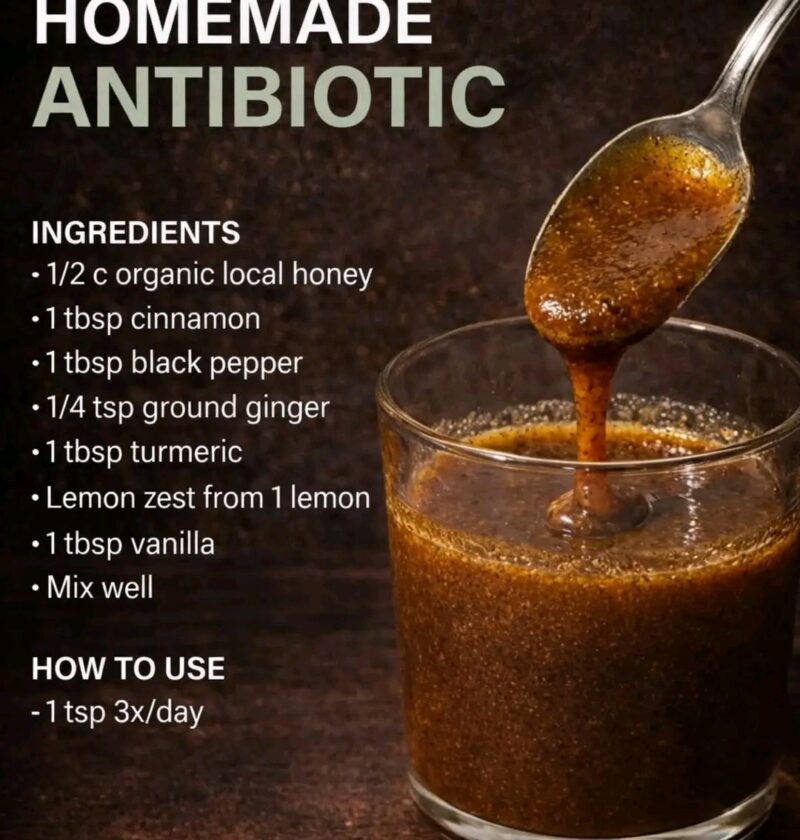
Although this recipe is sometimes shared online under names such as “homemade antibiotic,” it is important to clarify that this mixture is not an antibiotic and should not be used to treat a bacterial infection.
Antibiotics are prescription medicines used for certain bacterial infections, and they do not treat viral illnesses such as colds or flu.
Instead, think of this as a flavorful honey-spice preparation that can be enjoyed in small amounts.
Honey has some evidence for soothing nighttime cough in children with colds, although it should never be given to children under 1 year of age.
Recipe Overview
| Category | Details |
|---|---|
| Recipe Name | Homemade Honey, Turmeric & Spice Wellness Blend |
| Preparation Time | 10 minutes |
| Cooking Time | No cooking required |
| Total Time | 10 minutes |
| Yield | Approximately 1½ cups |
| Serving Suggestion | 1 teaspoon |
| Cuisine | Homemade / Wellness |
| Main Ingredients | Honey, turmeric, cinnamon, black pepper, ginger |
| Skill Level | Easy |
| Storage | Refrigerate in a clean, airtight jar |
Why You’ll Love This Recipe
This recipe is incredibly simple because it requires no cooking and uses ingredients that are easy to find. The combination of honey, warming spices, lemon zest, and vanilla creates a concentrated mixture with a pleasant balance of sweetness, spice, and citrus.
It is also versatile. You can enjoy a small spoonful as prepared, or stir a little into warm water or tea for a comforting drink.
Honey and spices are popular ingredients in many traditional home recipes, although the mixture should be viewed as a food rather than a medicine.
Ingredients
Main Ingredients
| Ingredient | Amount | Purpose |
|---|---|---|
| Organic local honey | ½ cup | Sweet base and smooth texture |
| Ground cinnamon | 1 tablespoon | Warm, aromatic flavor |
| Ground black pepper | 1 tablespoon | Strong peppery flavor |
| Ground ginger | ¼ teaspoon | Warm, slightly spicy flavor |
| Ground turmeric | 1 tablespoon | Earthy flavor and golden color |
| Lemon zest | From 1 lemon | Fresh citrus aroma |
| Vanilla extract | 1 tablespoon | Smooth, sweet aroma |
Ingredient Notes
Use a good-quality honey with a smooth consistency. Local honey can be used if preferred, but there is no need to purchase an expensive specialty honey for this recipe.
Ground turmeric works well and keeps preparation quick. Freshly grated turmeric can also be used, although it will change the texture and may shorten the practical storage life.
The original image uses 1 tablespoon of black pepper, which creates a very strong, spicy mixture. If you prefer a milder flavor, you can reduce the black pepper to 1–2 teaspoons.
Step-by-Step Instructions
Step 1: Prepare the Lemon
Wash and dry one lemon thoroughly. Finely grate only the yellow outer layer of the peel, avoiding as much of the bitter white pith as possible.
Step 2: Combine the Dry Ingredients
Add the cinnamon, black pepper, ground ginger, and turmeric to a clean mixing bowl. Stir them together so the spices are evenly distributed.
Step 3: Add the Honey
Pour in ½ cup of honey and mix slowly with a clean spoon or small whisk. Continue stirring until the spices are evenly incorporated.
Step 4: Add Lemon Zest and Vanilla
Add the freshly grated lemon zest and 1 tablespoon of vanilla extract. Stir thoroughly until you have a thick, evenly mixed honey-spice paste.
Step 5: Transfer to a Jar
Spoon the mixture into a clean, dry glass jar with a tight-fitting lid. Scrape the bowl well so you do not waste the flavorful honey mixture.
Step 6: Rest Before Serving
For the best flavor, allow the mixture to rest for about 30 minutes before serving. This gives the spices and lemon zest time to blend with the honey.
Best Tips
Choose fresh, fragrant spices because older spices can taste flat and dusty. Fresh lemon zest also makes a noticeable difference, adding brightness that balances the strong turmeric and black pepper.
Because honey is thick, mix slowly rather than whisking aggressively. If the mixture becomes difficult to stir, let it sit at room temperature for a few minutes before mixing again.
If you have never made a concentrated honey-spice mixture before, start with a small amount to see how your body responds.
Turmeric and ginger can cause digestive discomfort in some people, and herbal ingredients can interact with medications.
Best Ingredient Options
For the honey, raw, regular, or local honey can be used according to your preference and availability. Choose a honey with a flavor you enjoy because it makes up the largest portion of the recipe.
For cinnamon, Ceylon cinnamon offers a delicate flavor, while cassia cinnamon has a stronger, more familiar cinnamon taste.
Cinnamon is generally considered safe in amounts commonly used as a food spice, but evidence does not clearly support cinnamon supplementation for treating health conditions.
For turmeric, use culinary-grade ground turmeric rather than a concentrated curcumin supplement. The research on turmeric for health conditions remains limited, and concentrated formulations can have additional safety concerns.
Recipe Variations
For a milder version, reduce the black pepper substantially and use only a small amount of cinnamon. This creates a sweeter preparation that is easier to enjoy by the spoonful or mix into warm tea.
For a citrus-forward version, add a little more fresh lemon zest while keeping the honey quantity the same. You can also replace part of the vanilla with a small amount of orange zest for a different flavor profile.
For a warm drink, stir a small amount of the finished mixture into a mug of warm—not boiling—water or tea. This turns the thick mixture into an aromatic honey-spice beverage.
What to Serve With
This honey-spice mixture pairs naturally with warm tea, herbal tea, hot water with lemon, oatmeal, plain yogurt, or toast. It can also be used as a flavorful sweetener for certain breakfast foods.
For a simple wellness drink, stir approximately 1 teaspoon into a cup of warm water and adjust the amount according to taste. Remember that this is a food preparation rather than a medical treatment.
Make-Ahead Instructions
This recipe is already designed to be made ahead. Prepare the mixture, transfer it to a clean airtight container, and refrigerate it until needed.
For the best quality, prepare relatively small batches rather than keeping a large quantity for a long period, particularly because fresh lemon zest is included.
Storage
Store the mixture in a clean, airtight glass jar in the refrigerator. Always use a clean, dry spoon when serving to reduce the introduction of moisture or contaminants.
Because this recipe contains fresh lemon zest and no commercial preservation system, do not assume that it has the same shelf life as commercially prepared honey products.
If you notice mold, fermentation, an unusual odor, bubbling, or a significant change in appearance, discard it.
Reheating
There is no need to reheat this recipe.
If refrigeration makes the honey mixture too thick, allow the jar to sit at room temperature briefly and stir before serving. Do not microwave the mixture in a sealed jar.
Freezing
Freezing is not recommended because the texture of honey and the fresh lemon zest can change after freezing and thawing.
For convenience, it is better to prepare a small batch and store it properly in the refrigerator.
Common Mistakes to Avoid
Using too much black pepper can make the mixture extremely hot and overpower the honey, turmeric, and lemon.
The original recipe calls for 1 tablespoon, but reducing it is perfectly reasonable if you prefer a gentler flavor.
Another common mistake is treating the mixture like a pharmaceutical product. Despite the popular name “homemade antibiotic,” it has not been established as an antibiotic treatment.
Antibiotics should be used only when medically appropriate and exactly as prescribed.
Avoid giving honey to infants younger than 1 year because of the risk of infant botulism.
It is also important not to assume that “natural” automatically means risk-free. Turmeric can cause digestive side effects, and ginger may cause abdominal discomfort, heartburn, diarrhea, or mouth and throat irritation in some people.
Nutrition Estimate
Approximate values per 1 teaspoon; actual nutrition will vary depending on the honey, exact yield, and amount of spices used.
| Nutrient | Estimated Amount |
|---|---|
| Calories | 20–25 kcal |
| Carbohydrates | 5–6 g |
| Total Sugars | 5–6 g |
| Protein | Less than 0.2 g |
| Fat | Less than 0.1 g |
| Fiber | Less than 0.2 g |
| Sodium | Very low |
Frequently Asked Questions
Is this homemade antibiotic?
No. Despite the name sometimes used on social media, this honey-and-spice mixture is not an antibiotic. Antibiotics are medicines used against certain bacterial infections and should be taken according to professional medical advice.
Can this recipe cure a cold or flu?
There is not enough evidence to say that this combination cures or treats a cold or flu. Honey has some evidence for helping with cough symptoms in certain situations, but the entire mixture should not be considered a treatment for infection.
Can children have this recipe?
Children under 1 year should not consume honey because of the risk of infant botulism. For older children, speak with a pediatric healthcare professional if you are considering using concentrated spice mixtures, particularly if the child takes medication or has an underlying condition.
Can I take this every day?
This recipe is a food preparation, not a prescribed supplement or medication, so there is no medically established daily therapeutic dose.
The image suggests 1 teaspoon three times a day, but that instruction should not be interpreted as a medically recommended dosage.
Does turmeric have health benefits?
Turmeric and curcumin have been studied for several health conditions, but the evidence is not strong enough to conclude that turmeric is beneficial for every condition for which it is promoted.
Can I use this instead of prescription medication?
No. A homemade honey-spice preparation should never replace prescribed medication, antibiotics, professional medical care, or an appropriate diagnosis.
Can I use this recipe if I take medication?
Ask a doctor or pharmacist before using concentrated amounts of herbs or spices if you take medication. Ginger and turmeric can have potential interactions or side effects, and individual circumstances matter.
Is this suitable during pregnancy?
Do not assume that concentrated amounts of turmeric or herbal ingredients are appropriate during pregnancy.
NCCIH notes that turmeric supplements during pregnancy may be unsafe, while information about amounts beyond those normally found in food is limited. Consult a healthcare professional before using this type of preparation.
Final Thoughts
This homemade honey, turmeric, and spice blend is an easy way to combine familiar culinary ingredients into a flavorful preparation.
Honey, lemon zest, cinnamon, turmeric, ginger, black pepper, and vanilla create a distinctive mixture that can be enjoyed in small amounts or stirred into a warm beverage.
For a responsible natural wellness recipe, it is important to keep expectations realistic. This mixture is food, not an antibiotic or replacement for medical treatment.
If you have symptoms of an infection, symptoms that are severe or persistent, or concerns about medications and interactions, seek advice from a qualified healthcare professional.
Antibiotics should only be used when appropriate for bacterial infections and should never be replaced by a homemade remedy.
⚠️This recipe may not be suitable for everyone, so it is advisable to consult a doctor.